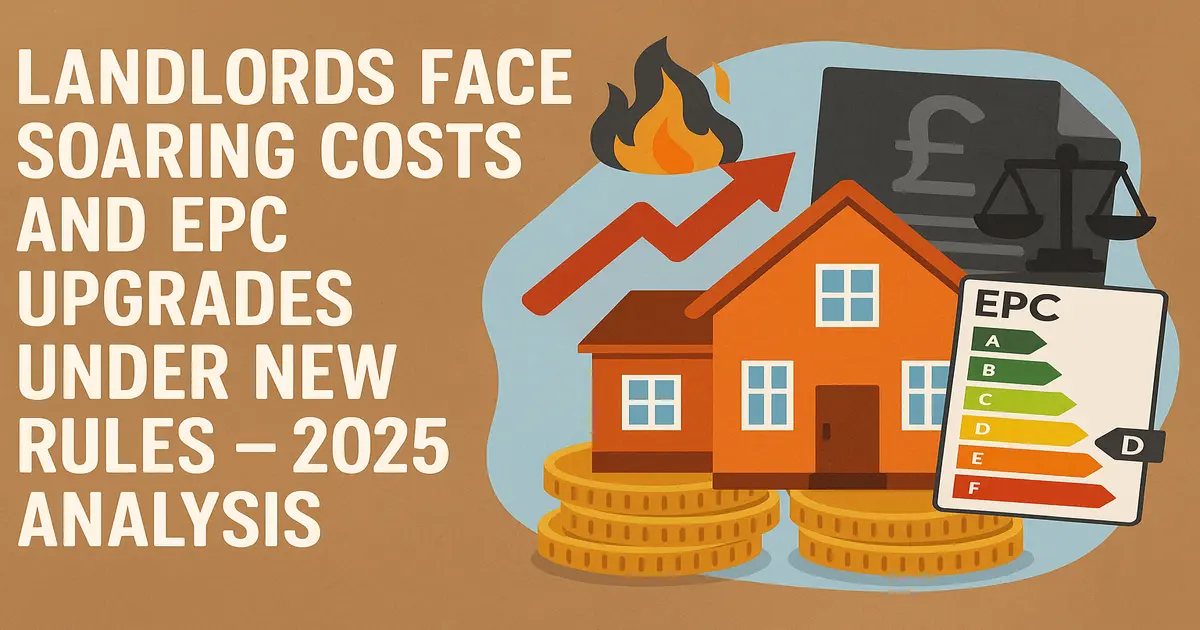
Landlords Face Soaring Costs and EPC Upgrades Under New Rules – 2025 Analysis
In 2025, landlords across England and Wales are facing a double threat: rising costs and increasing regulatory pressure driven by Energy Performance Certificate (EPC) requirements.
The government’s push towards net-zero carbon emissions has led to a tightening of EPC standards, leaving many landlords scrambling to make expensive property upgrades just to stay compliant.
While the green agenda is widely supported in principle, its rollout has proven to be anything but smooth – especially for small-scale landlords who already operate on tight margins.
This article explores the implications of the EPC reforms for landlords, the reasons behind the downgrades, the hidden costs of compliance, and what proactive steps property owners can take to safeguard their investments.
What Are EPCs and Why Are They So Important?
An Energy Performance Certificate (EPC) rates the energy efficiency of a property on a scale from A (most efficient) to G (least efficient). Since 2008, landlords have been required to provide EPCs when letting a property.
The certificate is valid for 10 years and includes recommendations for improving energy efficiency.
But EPCs are no longer just informational. They are now central to a landlord’s legal right to rent out a property.
Under the current Minimum Energy Efficiency Standards (MEES), landlords cannot let out residential or commercial properties with an EPC rating below E – and this threshold is set to rise shortly.
The UK government has proposed raising the minimum EPC requirement for new tenancies to C by 2028, with all tenancies expected to comply by 2030.
While these changes are not yet legally binding, the market is already shifting in anticipation, and landlords are facing mounting pressure from lenders, insurers, and tenants to meet the upgraded standards.
EPC Downgrades: Why Are They Happening Now?
Landlords are reporting a sharp increase in unexpected EPC downgrades following new assessment guidelines and the use of revised software by assessors.
A property that previously scored a C may now be downgraded to a D or even an E without any physical changes to the building.
Key reasons for EPC downgrades in 2025 include:
Stricter Software Modelling: Updates to EPC assessment tools have led to more conservative calculations, particularly around insulation, ventilation, and heating efficiency.
Outdated or Missing Data: EPC assessors may penalise properties for missing documentation or unverified upgrades (e.g. if insulation was installed without certification).
Changes to SAP Calculations: The government’s Standard Assessment Procedure (SAP) methodology – the backbone of EPC calculations – was updated in late 2024, changing how homes are scored.
Inflation of Energy Prices: With electricity prices fluctuating, the cost-effectiveness of electric heating systems has diminished in EPC modelling, impacting many urban flats that rely on electric radiators or storage heaters.
These downgrades are not just administrative headaches – they carry legal, financial, and operational consequences.
Soaring Costs: The Real Price of Compliance
For landlords with properties rated D or below, meeting the proposed EPC C target could mean shelling out thousands – if not tens of thousands – of pounds per property.
These upgrades are not cosmetic improvements but structural and mechanical overhauls that often require significant tenant disruption.
Common (and costly) EPC-related upgrades include:
- Loft insulation (£1,000–£2,000)
- Wall insulation (internal or external, up to £10,000)
- Upgrading boilers to energy-efficient models (£2,500–£4,000)
- Double or triple glazing (£5,000–£12,000 depending on size)
- Installing air source heat pumps (£7,000–£15,000)
- Solar panels or photovoltaic systems (£6,000–£10,000)
Small landlords who own one or two properties – especially those bought before 1990 – are most at risk of EPC non-compliance, particularly in regions like the North West and Midlands where older housing stock is prevalent.
What makes this situation worse is the absence of meaningful government grants for landlords. While there are some schemes offering limited support, they are often oversubscribed, difficult to apply for, or restricted to homeowners, not landlords.
Implications of Non-Compliance
Landlords who fail to comply with EPC standards risk significant penalties:
- Fines of up to £30,000 per property for non-compliance under MEES regulations.
- Void periods if a property cannot be lawfully rented.
- Mortgage complications, as many buy-to-let lenders now require properties to meet a minimum EPC level before issuing loans or refinancing.
- Reduced market value for properties with poor EPC ratings.
- Tenant dissatisfaction, especially among younger renters who prioritise energy efficiency.
There’s also a growing trend of letting agents refusing to market properties below a certain EPC threshold, further reducing landlords’ ability to attract tenants.
The Commercial Landlord Squeeze
The commercial property sector is not immune. Offices, shops, and industrial units are subject to similar MEES rules. From 1 April 2023, it became unlawful to continue letting a commercial property with an EPC rating of F or G.
Future legislative proposals indicate the minimum standard could rise to C by 2027 and B by 2030.
This will have a chilling effect on landlords with older office blocks, retail high street units, or warehouse premises, many of which are energy-inefficient due to poor insulation, old lighting systems, or outdated HVAC equipment.
Are These Rules Achievable – Or Are Landlords Being Set Up to Fail?
Many landlords argue that the government’s EPC goals are laudable in principle but dangerously unrealistic in practice. Critics point out that:
- The EPC system is flawed, with inconsistent assessments and a lack of standardisation between inspectors.
- The timelines are too aggressive, especially without comprehensive financial support.
- Listed buildings and older properties often cannot be retrofitted without breaching heritage or planning restrictions.
- The burden falls disproportionately on smaller landlords with limited access to capital or energy advisors.
These concerns are echoed by landlord associations, industry experts, and even some MPs, many of whom have called for a delay in implementing the EPC C mandate or for a tiered approach based on property type and location.
Strategies Landlords Can Use Now
Despite the regulatory challenges, landlords are not powerless. Here are key strategies to consider:
Commission a New EPC Assessment
If your certificate is old or based on outdated assumptions, a new assessment using the latest data and upgrades may improve your score.
Implement Low-Cost Improvements First
Measures like draft-proofing, switching to LED lighting, and installing smart thermostats can raise EPC scores at relatively low cost.
Prioritise High-Impact Upgrades
Focus on improvements that offer the biggest jump in SAP score per pound spent. Wall insulation, glazing, and efficient heating systems often yield the best results.
Keep Records of All Work Done
Always retain documentation for insulation, heating system upgrades, and building materials. Assessors need this evidence to credit improvements in their modelling.
Explore Funding and Loans
Investigate local council grants, green home finance products, or tax-deductible upgrade loans specifically designed for landlords.
Review Portfolio Profitability
For some landlords, the economics may no longer stack up. It may be better to sell underperforming or non-compliant properties than to invest heavily in upgrades.
The Bigger Picture: Green Policy vs Housing Supply
There is a growing concern that overly aggressive energy rules could reduce the availability of rental housing – particularly in low-income areas where landlords cannot justify large-scale retrofit investments.
Some fear that instead of helping the environment, the rules could contribute to homelessness and push landlords out of the market.
Balancing climate policy with rental market sustainability will be one of the government’s biggest housing challenges in the coming years.
If the EPC standards are not carefully implemented with practical support, it may do more harm than good to the UK’s already strained private rental sector.
Final Thoughts
Landlords are not resisting green progress – they’re resisting unaffordable, unclear, and unfair transitions.
The EPC upgrade drive has noble goals but currently lacks the structure, funding, and fairness needed to succeed. Without urgent adjustments or targeted support, many landlords may exit the market altogether, further tightening supply and raising rents for tenants.
A more effective path would involve:
- EPC reform and assessment standardisation
- Accessible grants for retrofit work
- Phased timelines that reflect market readiness
- Greater consultation with landlord organisations
Until then, landlords must brace themselves for higher costs and complex decisions ahead.
FAQs
What is the current minimum EPC rating for rental properties?
The minimum EPC rating currently required for new and existing tenancies in England and Wales is E. Properties with a rating of F or G cannot legally be rented unless exempt.
Will landlords have to meet EPC C by 2028?
The government has proposed that all new tenancies will need an EPC rating of C or above by 2028 and all tenancies by 2030. These proposals are not yet law, but many in the sector are acting in anticipation.
What happens if I rent out a property with an EPC rating below the legal minimum?
You could face enforcement action and fines of up to £30,000 per property under the Minimum Energy Efficiency Standards regulations.
Why was my property downgraded on its latest EPC?
Downgrades are often caused by updated assessment software, missing documentation, or changes to how certain energy features are scored in the SAP calculation.
Are EPC assessments consistent?
Unfortunately, EPC assessments can vary significantly between assessors. This inconsistency is one of the main criticisms of the current system.
Can listed buildings be exempt from EPC upgrade requirements?
Some listed buildings may qualify for exemption if the required work would unacceptably alter their character. However, exemptions must be registered and justified.
What low-cost improvements can I make to improve my EPC?
Installing LED lighting, draught-proofing doors and windows, insulating hot water tanks, and sealing gaps around pipework are relatively affordable upgrades that can boost your EPC.
Can I get help with the cost of improvements?
There are limited funding options for landlords. Some local authorities offer grants, and there are emerging green mortgages or retrofit loan schemes, but national support remains patchy.
How often should I get a new EPC?
EPCs are valid for 10 years, but you can commission a new one at any time – especially if you have made improvements that could raise your score.
Will failure to meet EPC C affect my ability to get a mortgage?
Yes, many lenders are tightening their criteria and may refuse buy-to-let mortgages or refinancing if your property does not meet future EPC requirements.
The British Landlords Association is a national landlords’ association for UK landlords. It is one of the largest landlord associations in the UK. Join us now for £79.95!
Our top-read blogs
Tenant Referencing & Credit Checks Special offer 33% off Now